

📝 Disclaimer: The content on this site is for informational and entertainment purposes only and does not constitute professional technical advice. Always exercise caution and research thoroughly before modifying game files, installing third-party software, or adjusting hardware settings.
* This post may contain affiliate links. As an Amazon Associate, we earn from qualifying purchases at no extra cost to you.
* This site uses AI technology for content assistance and illustrative imagery. Images are for demonstration purposes and do not depict real people or events.
Procedural Generation as a Game-Design Term
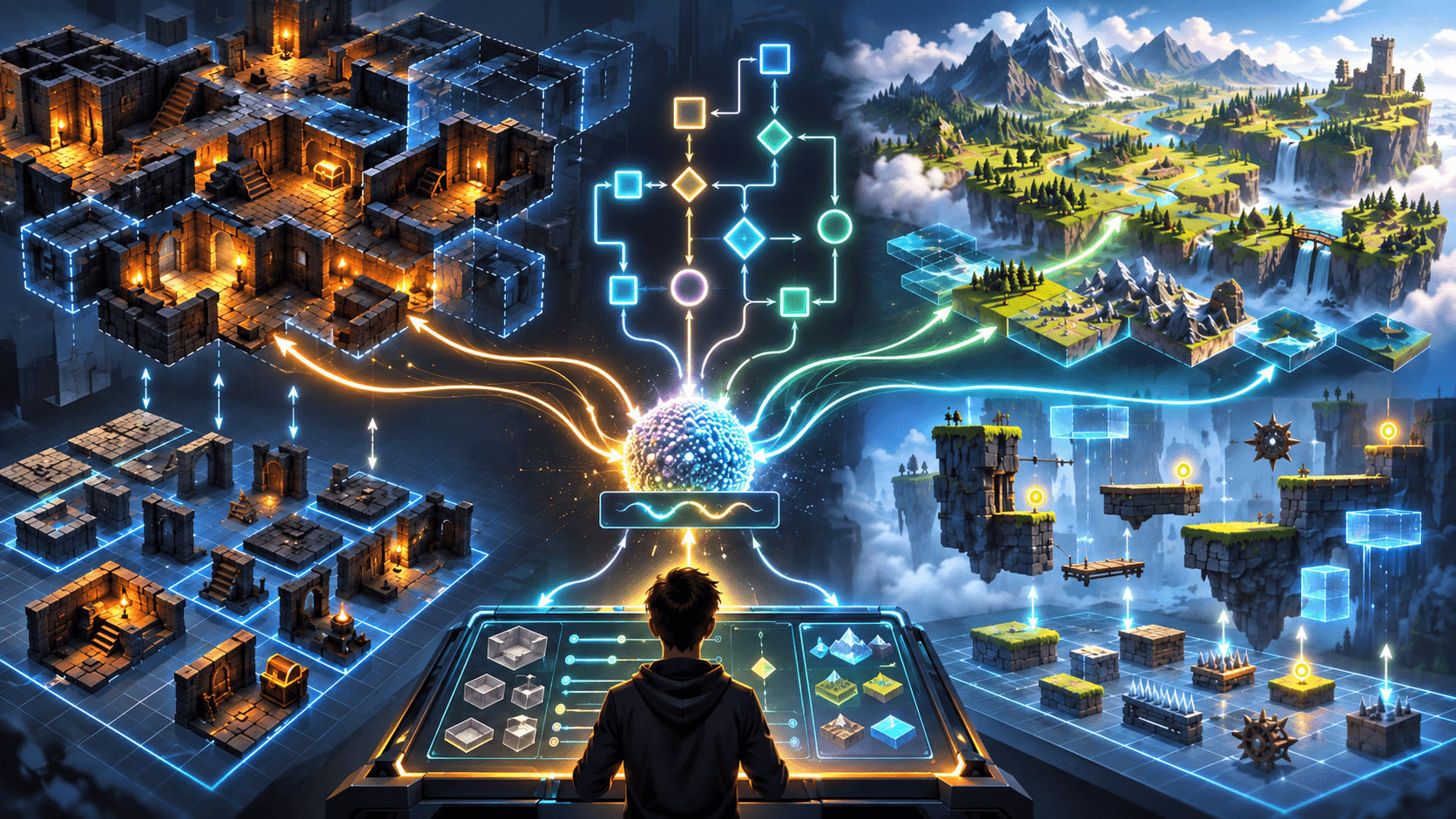
Procedural generation describes the use of programmed rules to create some game content rather than placing every element manually. The generated material may include maps, rooms, terrain, item arrangements, enemy placement, quests, weather patterns, or other environmental details. The exact meaning depends on the game’s systems and on how much of its content is produced through algorithms.
The term does not identify one genre. It can appear in role-playing games, dungeon crawlers, survival games, strategy titles, platformers, simulation experiences, and experimental projects. Some games use procedural methods for nearly every play session, while others apply them to limited areas within a largely hand-authored structure.
How Procedural Systems Shape Game Structure
A procedural system usually combines rules, parameters, and available content elements. The rules define how pieces can be arranged, while parameters influence variables such as room size, terrain form, object distribution, or encounter frequency. Designers may also establish boundaries that keep generated results consistent with the game’s broader setting and mechanics.
This approach can affect pacing and spatial organization. A game may present changing routes, rotating level layouts, or different combinations of challenges between sessions. In other cases, procedural generation supports background details that do not substantially alter the main progression. The generated outcome can therefore range from a central structural feature to a supporting production technique.
Procedural generation is distinct from simple randomness. Random selection chooses from available possibilities, whereas procedural generation generally uses relationships and rules to produce a more organized result. A system can also use fixed seeds, allowing the same parameters to recreate a particular arrangement, though the way this functions varies by game.
Design, Narrative, and Presentation Contexts
Procedural content may influence how a game communicates place and discovery. Changing environments can support themes involving exploration, instability, reconstruction, simulation, or repeated journeys. In narrative-focused games, generated elements may operate alongside fixed characters, authored dialogue, and predetermined story events rather than replacing them.
Visual presentation also affects how procedural results are understood. Stylized environments may make repeated structural patterns more visible, while detailed simulations can use generated variation to support a sense of environmental activity. Sound, lighting, and effects may respond to generated spaces, although these presentation systems are separate features rather than automatic consequences of procedural generation.
The label can describe a production method, a gameplay system, or both. A developer may use algorithms to reduce manual placement work, create large environments, or produce combinations that would be difficult to author individually. The resulting experience still depends on the rules, content library, testing process, and presentation choices surrounding the system.
Boundaries and Related Terminology
Procedural generation is often discussed alongside terms such as procedural content, algorithmic design, randomized levels, emergent behavior, and replay variation. These expressions overlap, but they are not interchangeable in every context. Emergent behavior usually refers to complex results arising from interacting systems, while procedural generation focuses more directly on how content or arrangements are produced.
The term also differs from user-created content. Procedural systems generate material through software rules, whereas user-created content is authored or assembled by players or communities. A game can contain both approaches, and one system may provide tools that influence the other.
Non-Prescriptive Classification Points
- Generated environments: Maps, rooms, terrain, or routes are produced partly through programmed rules.
- Rule-based variation: Parameters and constraints shape how possible results are assembled.
- Randomized layouts: A game may alter spatial arrangements between sessions or stages.
- Procedural content: Items, encounters, quests, or environmental details can be generated rather than individually placed.
- Authored and generated material: Fixed narrative elements may coexist with variable spaces or object arrangements.
- Production technique: Procedural methods can support development without defining the entire game structure.
- Genre-neutral terminology: The label can occur across multiple game genres and presentation styles.
- System-dependent meaning: The scope and effect of procedural generation vary according to each game’s design.